
In recent years, the adoption of AI, including its Generative subset, has surged across various industries, revolutionizing how businesses interact with customers and process vast amounts of data.
Organizations and industry representatives are increasingly exploring how to leverage this cutting-edge technology to improve customer engagement and personalize user experiences.
One of the prosperous areas for adoption is the EdTech. And you’ll be amazed by the numbers.
According to the report by McKinsey, education ranks among the top-5 of industries’ use cases. By estimates, generative AI can provide up to an extra $230 bln annually, increasing the industry revenue by up to 4%.
However, with the new developing technologies come new challenges. If you have ever taken any online courses, you know one of their biggest challenges: lack of feedback and tutoring support. Usually, you don’t have any mentors there.
In many cases, students find it challenging to navigate the courses independently.
If you’re stuck, you’re stuck. And you drop out of your online classes.
Why is it a problem for online education platforms?
Because selling a course isn’t sufficient; students who enroll and then quit don’t receive the total value they paid for.
Sometimes, students only pay on successful course completion. Or, scenarios like Coursera are also possible – when the courses are free, but students pay for the certificate. So if a student didn’t complete, they don’t pay.
While students’ wish to learn may not entirely fall under your responsibility, it does impact their course experience. If they end up feeling frustrated, it might hinder their positive recommendations. More importantly, such an experience can discourage them from enrolling in the future.
In this article, we addressed this problem. We shed some light on how ChatGPT and Langchain technologies combined reinvent the EdTech industry. And as always, we couldn’t help but build something new as an experiment, which will enhance the learning experience for students.
The ChatGPT-bot powered with LangChain
Generative AI-empowered solutions play a pivotal role in the EdTech industry’s significant momentum.
Earlier, the combination of ChatGPT and LangChain technologies has already proved its potential for eCommerce.
Now, an educational chatbot built on this powerful blend could help students with various tasks, including:
- answering questions;
- providing assignment feedback;
- offering personalized learning recommendations.
Students can also use these chatbots to access educational resources and support services, such as tutoring and counseling.
The chatbot provides convenient support, giving students a sense of guidance and assistance throughout their course journey. That’s what they seek and value.
Now let’s take a closer look at what students can apply it for.
Ask more detailed questions. Students can use the chatbot to request definitions, examples, and alternative explanations. This will enable them to delve deeper into the subject matter and gain a profound understanding of a specific topic. Engaging in more intricate questions allows learners to establish connections between various concepts and receive additional assistance in challenging areas, leading to a comprehensive grasp of the material and improved project success and graduation rates.
Requesting a recap. The bot can provide concise summaries of essential concepts for students’ learning process. This approach is handy for learners facing challenges with technical terminology or seeking rapid refreshers on specific topics during overwhelming projects.
Converting the text into other languages. Learners can use the chatbot to ask for translations of particular content into a language they’re better at. The chatbot’s capability to translate texts into different languages is beneficial for people who aren’t native English speakers. By overcoming language barriers, students can easily comprehend course materials, no matter what their native language is, which makes the learning experience better overall.

And it’s only part of what it is capable of. We’re pretty sure that the combination of ChatGPT’s self-training and LangChain’s agility can go far beyond that.
The Experimental Part
To back our claims with concrete evidence, we have developed our chatbot capable of giving required outputs based on a loaded PDF file.
What if we told you we created a chatbot that can google through your PDF as course content?
How we created it
In this experiment, we used Langchain with PDF files for question answering according to the given range.
As a pattern for our chatbot, we used this guideline and added the possibility of reading pdf files.
Our approach employed a question-answering chain, commonly utilized to combine a pre-trained language model (LLM) and a retrieval system. This chain operates by retrieving relevant documents through the retrieval system and generating answers based on the retrieved documents using the LLM. To simplify the process, we utilized Python and its Langchain module, which offers a standardized interface to access LLMs, supporting various models like Chat GPT, LLama, and GPT4All.
For our particular case, we accessed Chat GPT via the OpenAI API. We built a user interface using Streamlit, an open-source Python library designed to create intuitive web apps for machine learning and data science without needing JavaScript or CSS knowledge. The documentation can provide you with more detailed information.
As a result, users can upload a PDF file and ask questions about the corresponding text in PDF format.
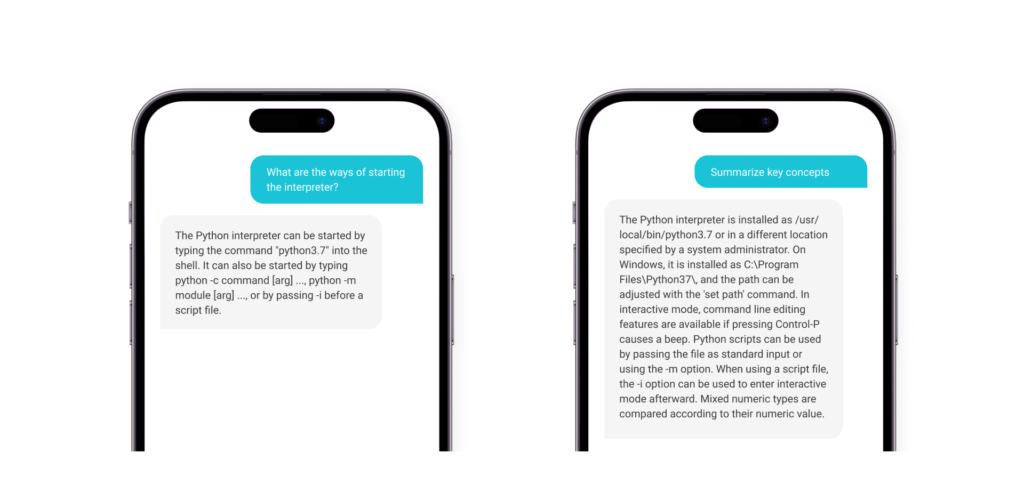
We used a python-tutorial book as a pdf file to complete this experiment. Because of the token limit of Chat GPT, we passed only the section that contains text about “USING THE PYTHON INTERPRETER” to LangChain with some questions.
The Communication We Built
Upon uploading our tutorial as a PDF file, we can now ask our chatbot specific questions and get precise answers.

The LangChain processes a PDF file to extract the required item from the database (text). This iterative process continues until it reaches the final answer, which the user gets through our chatbot.
For starters, we can begin with the following:
- What about this text?
This text provides information about using the Python interpreter, including invoking it on Unix and Windows, exiting it, and using command-line editing. It also explains how to run Python scripts and enter interactive mode afterward.
- Where is The Python interpreter usually installed?
/usr/local/bin/python3.7
- How to add a directory with Python to my path?
On Windows machines, you can add the Python directory to your path by typing the following command into the command prompt in a DOS box: set path=%path%;C:\Program Files\Python37\.
- What is a Python interpreter?
The Python interpreter is a program that runs Python code and commands and provides an interface for the user to interact with the language.
- Translate the first paragraph into Ukrainian.
Інтерпретатор Python, як правило, встановлюється як /usr/local/bin/python3.7 на тих машинах, де він доступний; додавання директорії /usr/local/bin до шляху пошуку на оболонці Unix дозволяє запустити його, набираючи команду: python3.7 до оболонки.
- Translate the first paragraph into German.
Der Python-Interpreter ist normalerweise als /usr/local/bin/python3.7 auf jenen Maschinen installiert, auf denen er verfügbar ist; wenn Sie /usr/local/bin in Ihren Suchpfad der Unix-Shell einfügen, können Sie ihn mit dem Befehl starten: python3.7 an die Shell.
- Translate the first paragraph into Spanish.
El intérprete de Python generalmente se instala como /usr/local/bin/python3.7 en aquellas máquinas en las que está disponible; poniendo /usr/local/bin en la ruta de búsqueda de la shell Unix hace posible iniciarlo escribiendo el comando: python3.7 a la shell.
The Results We Got
As you can see, we now have an educational chatbot that can help you provide a personalized experience for students.
Generally, it gives answers based on any text, as long as it is in PDF format. Of course, it can be fine-tuned to work with CSV as well.
For instance, one can ask questions about any book or specific text, prompt it to write the outline or characters, or generate a summary for any part of a tutorial or scientific work.
Giving a student a feeling of support, the chatbot completes several goals from the business point of view:
- Focuses on students’ needs with a tutor’s functions;
- Boosts their satisfaction level;
- Increases course completion rate.
Consequently, it provides a better customer experience, raising loyalty and promising more significant numbers of course purchases.
And that is another step to enhance the EdTech industry.
More is yet to come.
How EdTech Behemoths Leverage AI-empowered Tools
Many prominent online learning platforms have already recognized the potential of AI-enabled chatbots to revolutionize the learning experience and transform how students and educators interact with educational content. These are just a few of them:
Duolingo, a renowned language-learning platform with an extensive range of courses in over 40 languages, implements AI-driven chatbots like Max for learner support. Leveraging GPT-4 technology, Duolingo’s virtual assistants engage learners in their target language, offering instant feedback, answering inquiries, and providing valuable insights to facilitate efficient language acquisition. Additionally, the platform’s chatbots analyze student input, comprehend their questions and errors, and deliver personalized feedback, fostering encouragement and motivation throughout language learning. The chatbots also enhance the learning experience by offering contextualized language usage examples, making it more immersive and relevant to individual learner requirements.
Udacity, a popular online platform for open courses, has introduced its AI chatbot, powered by OpenAI’s GPT-4 Turbo and available in beta. The tool offers personalized support and guidance during the learning process while tackling real-world projects. The chatbot can handle an unlimited number of interactions simultaneously. Learners can benefit from real-time assistance, like having a virtual tutor, complementing the valuable human feedback and support from the platform’s global mentor network available throughout their educational journey.
Carnegie Learning, an innovative EdTech and curriculum solutions provider, integrates AI and machine learning into its learning platforms, focusing on math, literacy, and world languages for high-school and college-level students. Among its standout products is MATHia, developed by Carnegie Mellon University researchers, and Fast ForWord, a reading and language software fostering cognitive skills in students. Key features of Carnegie Learning’s platforms include AI-powered human tutor mimicking, personalized one-on-one learning experiences for each student, and actionable data insights to manage students’ progress effectively.
Wrapping Up
Overall, the combination of ChatGPT and LangChain technologies represents a compelling opportunity for the EdTech industry. These tools provide a unique way to enhance personalized and interactive learning experiences. By utilizing the conversational AI of ChatGPT and the language-based data-aware applications of LangChain, EdTech companies can provide unparalleled value. This integration empowers educators and learners alike, providing real-time assistance and revolutionizing how knowledge is accessed and shared in the digital age.
No matter which side of the spectrum you focus on – we’re always happy to help you with your intentions. We have already completed several similar projects, so if you want to talk to our experts, let’s discuss it!