The EdTech market is surging past its post-COVID slump, fueled by the effect of Artificial Intelligence (AI). After reaching a value of $1.82 billion in 2021, the integration of AI in education is predicted to witness a compound annual growth rate (CAGR) of 36.0% and bring $32.27 billion in 2030.
Today, AI chatbots, with their personalized and data-driven approach, are fundamentally changing how we learn and teach. But their impact is merely the first wave in this educational transformation. AI’s potential extends far beyond that and offers a vast toolkit to improve education at different levels. In this article, we will take a closer look at the world of intelligent EdTech, exploring the diverse applications of AI, both generative and beyond, and how they will impact education in the future.
From the pandemic to AI: Recent changes in EdTech
Education found itself scrambling to adapt in the face of the COVID-19 pandemic. Classrooms all over the globe fell silent, replaced by the flickering glow of remote learning platforms. This wasn’t a seamless transition. Educators, students, and parents alike grappled with the challenges and intricacies of e-learning.
Even after students and educators returned to in-person learning, the lingering effects of the pandemic continue to become apparent. Recent results from the Programme for International Student Assessment (PISA) 2022, a global education survey, revealed a decline in student performance in math, reading, and science across many participating countries, as shown in the graph below.

It’s important to note that these results in educational performance are only partly attributable to the COVID-19 pandemic. Pre-existing issues like educational inequality and gaps in access to technology have been exacerbated during the lockdowns. That’s why it would be simplistic to assign all blame to the pandemic itself.
Nevertheless, while the global lockdown presented challenges for education, its impact wasn’t solely negative. The pandemic was a catalyst for innovation in EdTech and sped up the adoption of online learning platforms. Markedly, it promoted new openness to technology in the classroom. Once hesitant, teachers and students embraced new ways of online communication and learning. This shift revealed a surprising degree of adaptability and resilience within education and paved the way for the integration of technology-driven solutions long after the pandemic subsided.
The 2022 release of ChatGPT, a conversational chatbot by OpenAI, became a watershed moment for EdTech. Its ability to provide extensive explanations, write creative content, and answer questions sparked both excitement and concern, as a recent Nature article suggests. The widespread bans of ChatGPT in some US schools highlight the doubts surrounding its use. Educators are worried about its potential to facilitate plagiarism, short-circuit critical thinking, and perpetuate misinformation if not used responsibly.
While students approach AI-powered tools with a mix of excitement and caution, a significant number recognize the potential of AI to improve the learning experience. A 2023 Statista survey in the US shows that a majority of undergraduate students believe AI will bring positive changes to education. They also express a strong preference for AI tools developed within the trusted environment of academia (see a graph below).
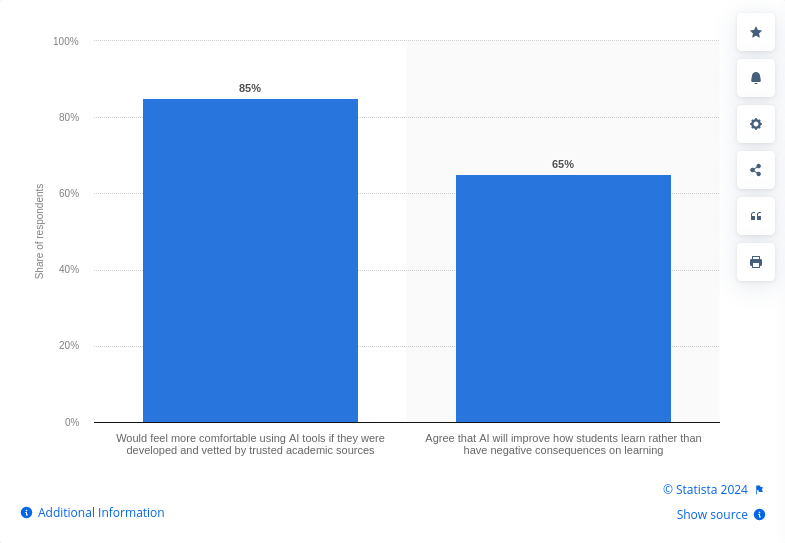
This positive outlook is a promising sign. A growing acceptance makes it possible to explore high-impact use cases where AI can make a tangible difference in teaching and learning. If AI is embraced and thoughtfully integrated into classrooms, it can become a powerful equalizer. The challenge and the opportunities now lie in harnessing its power ethically and effectively.
Traditional AI vs. Generative AI
Before exploring the use cases of AI in education, let’s discuss several crucial technical aspects. In essence, AI is the simulation of human intelligence in machines. It encompasses a vast array of techniques, from Machine Learning (ML) algorithms that can learn from data without explicit programming to Natural Language Processing (NLP) that allows computers to understand and respond to human language.
Traditional AI can perform numerous tasks like playing chess, classifying emails, predicting trends, or segmenting customer groups. By doing so, it relies upon structured data, as well as rules and logic that were pre-programmed. One of the main disadvantages of traditional AI models is that they lack flexibility and often struggle with nuanced real-world situations.
Generative AI is a type of technology that overcomes these limitations. It can generate brand-new content like text, images, video, and code based on the patterns it finds in massive chunks of data. This feature makes generative AI models more versatile and autonomous compared to their traditional counterparts. Here is a closer look at the major differences between traditional AI and generative AI:

An example of traditional AI is a chatbot you might talk to on a customer support line. It follows certain rules and responses, rigidly defining the course of a dialogue. Generative AI chatbots like ChatGPT-4 can handle communication more effectively because they have learned from massive amounts of real human conversations and can create new information. There is one distinct trade-off, though. Generative AI may sometimes make up plausible but incorrect responses called ‘hallucinations’ and pretend to know things it does not actually understand. This means generative AI models require continuous monitoring and alignment by humans. Professionals often use traditional AI and generative AI in tandem.
Interestingly enough, even before the release of ChatGPT, AI had started infiltrating education. AI-powered tools were developed to automate assessment or support language learners. For example, AI could take over some grading tasks, especially for multiple-choice or short-answer formats or AI-powered translation tools and language learning apps could assist students with limited proficiency in the language of instruction.
High-impact use cases of AI in education
Can AI help educators shift the focus from grading to learning and bring new approaches to education? The question remains open-ended, but the technology has proven effective in numerous areas, such as
- Personalized learning
Armed with student data insights, AI can personalize learning experiences. Imagine an AI platform that curates a unique playlist of learning materials for each student. This number might include targeted practice problems, video explanations tailored to individual learning styles, and interactive simulations that reinforce complex concepts. This shift from a static, one-size-fits-all curriculum to a dynamic and personalized approach can improve academic outcomes and also cultivate a love of learning that transcends standardized tests.
- Adaptive learning environments
Adaptive learning environments leverage AI algorithms to dynamically adjust the difficulty level, pace, and presentation of educational materials based on a student’s real-time progress and performance. These intelligent systems can identify areas where a student excels or struggles. They can also modify the learning experience and create a challenging yet manageable learning curve for growth and improved student’s skills.
- Intelligent tutoring systems (ITS)
Intelligent tutoring systems leverage AI to create virtual tutors and educational chatbots capable of real-time conversations. Rather than operating from a fixed curriculum, ITSs adapt pedagogical approaches, examples, and practice activities in response to the student’s needs and proficiency levels.
- Learning analytics
Learning analytics empowers AI to deliver the right content at the right time, such as video explanations, practice problems, or simulations, based on student data. What’s more, advanced learning analytics techniques, including predictive modeling and Machine Learning, can forecast student performance or identify potential dropout needs. These predictive capabilities enable educational institutions to stay ahead of emerging challenges and better prepare for future changes in education.
- Curriculum development
AI can be a valuable tool for educators in the process of curriculum development. Due to its ability to analyze student data and learning outcomes, AI can identify areas where the current curriculum might be lacking or overly complex. Besides, it can promote branching learning paths within the curriculum. This allows students who master a concept to progress to more challenging material, while offering targeted support for those who need additional practice.
- Administrative automation
Machine Learning algorithms can analyze enrollment, classroom utilization, and resource data to intelligently generate master schedules, classroom/seat assignments, transportation routes, and more. Besides, AI grading tools can automatically score multiple-choice, fill-in-the-blank, and short answer assessments. More advanced systems can provide feedback on written assignments.
On top of that, AI can ultimately become a tool for sparkling creativity or critical thinking, OpenAI highlights. In project-based learning, it could be an ever-present computational resource to explore “What if?” scenarios, rapidly prototype ideas, and validate approaches through simulation and modeling. Perhaps, this could help educators rethink outdated teaching strategies.
Advantages of AI in education for students and teachers
The integration of AI into educational technology offers a range of benefits for both students and teachers. Let’s look at some of the most important ones.

AI for students:
- Higher engagement
AI-powered educational tools can gamify the learning experience and increase student engagement. Features like interactive animations, immersive simulations, and rewards/scoring systems tap into the motivating power of gameplay. This can make challenging topics more compelling and enjoyable to learn.
- Improved accessibility
According to the World Economic Forum, widespread AI integration could bring education closer to some of the 250 million students who are currently out of the school system. AI can enable educational content to become more accessible through text-to-speech, speech recognition, language translation, and smart captioning capabilities. This expands equitable access to learning materials for students with disabilities, non-native language backgrounds, and other accessibility needs.
- Personalized feedback and assessment
With AI continually analyzing each student’s performance data, the technology can deliver precisely tailored feedback. Instead of generic comments, AI tutors can pinpoint knowledge gaps, provide guided practice on weak areas, and customize encouragement and explanations. AI-graded assessments can instantly show students which problems need revisiting.
AI for educators:
- New learning paths
Similar to personalized learning for students, AI can analyze a teacher’s instructional strategies or classroom management approaches and recommend tailored training content that upskill their capabilities.
- Burnout prevention
Grading, providing individualized feedback, and answering repetitive student questions are time-intensive tasks that contribute to teacher burnout. AI can automate parts of this workload through capabilities like automated grading, conversational tutoring assistants, and customized learning content curation.
- Data-driven insights
After collecting data on student engagement, comprehension levels, and performance metrics, AI solutions can empower teachers with rich analytics. These insights allow teachers to identify struggling students promptly, discover which lessons spark confusion, and evaluate the efficacy of different instructional methods to iteratively enhance their craft.
Although AI offers much-needed assistance, teachers maintain an essential role in cultivating emotional engagement, creative thinking, and ethical development – areas where the human touch remains unmatched compared to artificial intelligence alone. The goal is for AI and human educators to work in complementary partnership.
How top EdTech companies and startups integrate AI
Amid the rush for technological growth, both EdTech leaders and startups have started experimenting with generative AI offerings. In 2023, several industry giants announced the release of AI tutors. Some examples are Q-Chat from Quizlet, which answers student questions, and Khanmigo from Khan Academy, which helps students with exercises and even assists teachers. Here’s how some of the leading players and innovative startups are leveraging AI for a more personalized and effective learning experience:
- A language learning giant, Duolingo, uses AI extensively for adaptive placement tests, personalized lesson recommendations, and chatbot-based conversation practice. Their AI-powered bots offer realistic conversational experiences to learners.
- A widely popular online learning platform, Coursera, deploys AI to match learners with suitable courses, share personalized feedback on assignments, and suggest further learning pathways based on a user’s interests and goals. It also started a Generative AI Academy to equip executives and their employees with the foundational knowledge of this fast-evolving technology.
- A peer-to-peer learning platform, Brainly, created a mobile feature called “Snap to Solve” that tackles a common student struggle: finding answers to questions presented visually, like math problems or handwritten text.
- While not strictly an EdTech platform, Grammarly’s AI-powered writing assistant is widely used by students. It offers comprehensive grammar checks, style suggestions, and vocabulary improvement tools, enhancing language skills in real time.
The EdTech startup scene is buzzing with AI innovation. Companies like AfriLearn, focused on AI-powered accessible learning, and Bookbot Technology, which offers speech recognition technology for improved reading, are attracting investment. The recent surge in investments in AI-driven EdTech startups demonstrates the growing confidence in the potential of AI to upend teaching and learning. By 2025, AI capabilities could contribute $200 billion in added value to education providers, publishers, technology vendors, and other stakeholders serving the global education ecosystem, Morgan Stanley reports. All eyes are on EdTech companies in their quest for better learning experiences.
How to integrate AI through custom development
Although off-the-shelf large language models (LLMs) like ChatGPT offer versatile functionalities, many companies develop custom AI solutions to improve their educational offerings. There are several reasons behind this. First, off-the-shelf LLMs might not perfectly align with a company’s specific educational goals. Custom AI development allows them to tailor the AI features to their unique curriculum, target audience, and desired learning outcomes.
Second, custom solutions offer greater control over data security and privacy, which is paramount in the educational sector. Educational institutions have strict regulations regarding student data, and custom AI development allows companies to build systems that adhere to these specific requirements. To integrate AI through custom development, organizations often collaborate with specialized technology partners that have expertise in Machine Learning and NLP.
Unidatalab creates custom AI solutions for enterprises in education. Our services span the entire AI integration lifecycle, from initial consultation and requirement gathering to model development, deployment, and ongoing optimization. We work closely with educators, instructional designers, and technology teams to understand the business goals and target audiences of our partners and translate these insights into robust AI architectures and models.
The future of education with AI
Education, which has long resisted disruption, is now experiencing a renaissance driven by AI integration. Albeit its influence, this technology is not a magic bullet but a powerful way to personalize learning and help educators rethink their approaches to teaching. It is reshaping the dynamics of how students acquire knowledge, and how educators facilitate knowledge-sharing. That’s why the time is ripe to seize new opportunities that come with this change: contact us.