
Neural networks are capturing the world. Or do they?
The truth is that Artificial Intelligence can only support and help people conduct their mundane tasks. And it won’t take over the world. At least, for now.
This also relates to ChatGPT, which has already become a hallmark of technology in 2023. Sure, it’s rapidly gaining momentum for its ability to generate human-like text and engage in intelligent conversations. However, its potential goes beyond simply chatting with users. In our previous article about ChatGPT for customer service, we’ve already learned about the technology itself, its capabilities, limitations, and many more.
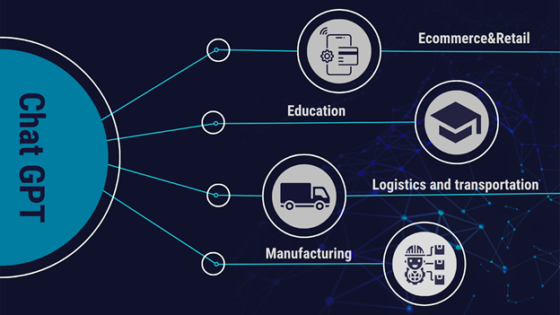
From e-commerce and manufacturing to logistics and education, ChatGPT has the potential to revolutionize how businesses operate and make decisions. This article explores some of the most promising ChatGPT use cases across industries and discusses how this innovative technology improves outcomes for organizations and their customers. Additionally, we’ll highlight some challenges and define the steps to take for wider technology adoption.
What makes ChatGPT useful across industries?
No doubt, many businesses have already acknowledged that ChatGPT’s natural language processing capabilities and ability to learn from large amounts of data make it a valuable tool for improving performance in different industries.
There are several reasons why ChatGPT is ready to be implemented across multiple domains:
- Large and diverse training data: ChatGPT has been trained on large and varied datasets, including a broad range of texts, from social media posts to academic papers. This has enabled the model to develop a strong understanding of language and its nuances, making it capable of generating coherent and relevant responses to a wide range of queries.
- A growing level of fine-tuning: ChatGPT can be fine-tuned and customized to meet specific industry needs. This means businesses can train the model on their own data, making it more relevant and accurate for their particular use cases.
- Cost-efficiency: Compared to human labor, ChatGPT can provide language-based services at a lower cost (in the long run), making it an attractive option for businesses looking to improve efficiency and reduce costs.
- Scalability: ChatGPT can be scaled to handle a large volume of queries, making it suitable for industries such as e-commerce and customer service, where there may be a high volume of requests.
Speeding up the industries: the score is growing
ChatGPT can potentially increase efficiency in a wide range of industries by providing insights and recommendations based on large volumes of data across all industries. So let’s see how organizations can leverage the power of ChatGPT to make better decisions.
Ecommerce&Retail
ChatGPT can be applied in many ways to improve business and customer experiences. Here‘s how:
Product recommendations: ChatGPT can be used to provide personalized product recommendations to customers based on their preferences and browsing history. This can be achieved by training the model on customer data, such as purchase history, search queries, and demographics, and using this information to generate relevant recommendations.
Virtual shopping assistant: Companies can implement ChatGPT as a virtual shopping assistant to help customers find products and make purchase decisions. ChatGPT can help customers find products that meet their needs and preferences by asking questions and engaging in natural language conversations.
Sentiment analysis: Businesses can use ChatGPT to analyze customer sentiment by analyzing customer feedback and reviews. This can provide valuable insights into customer satisfaction and help businesses identify areas for improvement.
Product descriptions: By training the model on existing product descriptions and reviews, businesses can generate high-quality descriptions and reviews quickly and efficiently.
Logistics and transportation
The technology can benefit the logistics and transportation industry in various ways:
Route Optimization: Providers can employ ChatGPT to analyze transportation data, such as traffic patterns and delivery schedules, and identify optimal shipping routes. This can help logistics companies minimize delivery times, reduce costs, and improve overall efficiency.
Demand Forecasting: ChatGPT can be trained on transportation data to forecast logistics and transportation services demand. This can help logistics companies plan their operations more effectively, ensuring they have the necessary resources and capacity to meet customer needs.
Supply Chain Management: Businesses can apply ChatGPT to analyze data from across the supply chain, such as inventory levels and shipping times, to optimize logistics processes. This can help logistics companies reduce costs, improve delivery times, and enhance overall supply chain efficiency.
Natural Language Processing for Documentation: ChatGPT can be used to parse through and analyze documentation such as invoices, packing slips, and bills of lading. This can help logistics companies identify and flag errors, detect fraud, and improve accuracy in logistics documentation.
Manufacturing
ChatGPT can accelerate the manufacturing industry in several ways.
Quality control: ChatGPT can be trained on images of products and used to identify defects in the manufacturing process. It’s possible through transfer learning, where the ChatGPT model is fine-tuned on a labeled image dataset. As a result, manufacturers will identify quality issues early on and improve the overall quality of their products.
Predictive maintenance: Manufacturers can use ChatGPT to predict when equipment is likely to fail based on data from sensors and other sources. The model can be trained on sensor data to identify patterns indicative of impending equipment failure. Such an approach is possible using sequence-to-sequence models that can predict the future state of equipment based on past sensor data. As a result, manufacturers can plan maintenance schedules and reduce downtime more efficiently.
Inventory management: Companies can apply ChatGPT to predict product demand and optimize inventory levels. ChatGPT can be trained on time series models, forecasting future demand based on sales data and other external factors such as seasonality. As a result, this can help manufacturers reduce costs by avoiding excess inventory or stockouts.
Production scheduling: ChatGPT can be trained on production data such as machine availability, worker availability, and production targets and be used to generate production schedules that optimize production targets and minimize idle time. All in all, it helps manufacturers increase efficiency and reduce costs.
Education
ChatGPT technology has great potential to transform the education system as well.
Automated essay grading: Teachers can use ChatGPT to grade essays and provide students with feedback. The model can be trained on a large dataset of essays and their corresponding grades, learning to identify common patterns and provide accurate feedback on grammar, spelling, and other aspects of writing. This could save teachers’ time and allow them to provide more personalized feedback to each student.
Question answering and personalized learning: Students can ask questions related to their coursework, and ChatGPT can provide relevant answers, drawing on its extensive knowledge base of texts. This can be particularly useful for students who need help understanding a concept or additional support with a specific topic.
Language translation: Students can translate texts from one language to another, having access to educational materials in their native language. The model can be trained on a large dataset of translated texts, learning it to provide accurate and natural-sounding translations.
To use or not to use – that is the question
Although ChatGPT technology is advancing with every step, certain challenges still need to be considered before implementing it into specific domains, like healthcare, insurance, and banking.
- Privacy concerns: The mentioned industries are highly regulated and deal with sensitive and confidential information. ChatGPT relies on data to generate responses, and there may be concerns about privacy and security when it comes to sensitive data. For example, ChatGPT may accidentally disclose personal information or inaccurately respond to sensitive queries.
- Legal and regulatory compliance: Healthcare, insurance, and banking are all subject to strict legal and regulatory requirements. ChatGPT must be trained and implemented in compliance with these requirements, which can be complex and time-consuming.
- Lack of transparency: ChatGPT is a complex machine learning model, and its decision-making process can be challenging to interpret or explain. This lack of transparency can be a concern in industries where decisions need to be justified or explained to stakeholders, such as healthcare or insurance.
- Limited domain knowledge: While ChatGPT has a broad language understanding, it may lack domain-specific expertise in specific industries. For example, ChatGPT may need a deeper understanding of medical terminology or the latest medical research in healthcare. This could lead to inaccuracies and errors in its responses.
- Data bias: Like any machine learning algorithm, ChatGPT is only as good as the data it is trained on. ChatGPT may make incorrect assumptions or generate biased responses if the training data needs to be more complete. This could be particularly problematic in industries such as finance, where decisions based on ChatGPT’s replies could have significant financial implications.
Nevertheless, ChatGPT has many advantages that make it suitable for implementation even in such data-sensitive industries. Therefore, it’s critical to carefully consider the potential benefits and risks of using ChatGPT in these contexts and ensure appropriate measures are taken to ensure its safe use.
Yet, let’s shed some light on how the technology can help even in such disputable cases.
Healthcare
Given all the training capacity of ChatGPT, it can be used in healthcare in several ways:
Medical diagnosis and treatment recommendations: ChatGPT can be trained on large volumes of medical literature and patient data to provide diagnosis and treatment recommendations. ChatGPT can analyze the patient’s symptoms and medical history and provide recommendations based on its understanding of medical literature and best practices. It can also assist doctors in creating treatment plans and monitoring patient’s progress.
Patient engagement and education: ChatGPT can be used to engage patients and educate them about their medical conditions. For example, it can answer patients’ questions about their diagnosis, medications, and treatment options. This can help patients feel more informed and empowered in their healthcare decisions.
Mental health support: ChatGPT can be trained to recognize signs of mental health issues and provide support and resources to patients. For example, it can give information about mental health conditions, suggest coping strategies, and connect patients with relevant professionals.
Clinical documentation: ChatGPT can assist healthcare providers with clinical documentation, such as taking notes during patient visits. This can help streamline the documentation process, reduce administrative burden, and allow healthcare providers to spend more time with patients.
Medical research: ChatGPT can be used to analyze large volumes of medical literature and generate insights that can inform medical research. For example, it can identify patterns and correlations in medical data, suggest new research questions, and help identify potential new treatments.
Insurance
Here are several ways how ChatGPT can be a valuable tool for the insurance industry:
Automated Claims Processing: Companies can apply ChatGPT to automate the claims processing process. Customers can submit their claims through a chatbot interface powered by ChatGPT. The system can extract relevant information from the customer’s messages and verify the claim against the insurance policy.
Risk Assessment: Insurers can implement ChatGPT to assess the risk of insuring a particular individual or organization. The system can analyze data from various sources, such as social media, credit scores, and public records, to generate a risk profile for the applicant. This can help insurance companies make more informed decisions about which policies to offer and at what price.
Fraud Detection: Insurance providers can use ChatGPT to detect fraud in insurance claims. The system can analyze claims data and identify patterns that indicate potential fraud. For example, if the same individual submits multiple claims with different names or addresses, ChatGPT can flag these claims for further investigation. This can help insurance companies reduce losses due to fraudulent claims.
Banking
ChatGPT can be a valuable instrument for the banking industry, offering a range of options that can improve overall efficiency.
Fraud detection: Banking institutions can implement ChatGPT to detect and prevent fraudulent activities by analyzing transaction histories and identifying suspicious behavior patterns. This results from training the model on a dataset of past fraudulent transactions and patterns, enabling it to recognize similar patterns in future transactions.
Personalized financial advice: ChatGPT can be used to provide personalized financial guidance to customers based on their account history and financial goals. This results from training the model on a financial advice and recommendations dataset, enabling it to generate customized recommendations for each customer.
Loan and credit approval: Banks and financial institutions can use ChatGPT for assistance with loan and credit approvals by analyzing customer data and providing automated recommendations. This can be achieved by training the model on a loan and credit application data and outcomes dataset, enabling it to identify factors influencing loan and credit approval decisions.
Risk assessment: The ChatGPT technology can be applied to assess and predict financial risks by analyzing historical data and identifying potential risks. This results from training the model on a financial data and risk assessment dataset, enabling it to generate predictions and recommendations for minimizing financial risks.

What’s next?
There’s always room for growth for any technology and its fast-paced implementations. This relates to ChatGPT as well.
Here are several steps that both industries’ players and technology developers could take:
- Standardization of data and processes: Standardizing data and processes can help to ensure that ChatGPT can be used effectively across different industries. This includes establishing best practices for data collection, labeling, and cleaning and developing standardized processes for training and deploying models.
- Collaboration between industry experts and AI researchers: Collaboration between industry experts and AI researchers can help identify the most promising use cases for ChatGPT and ensure that the technology is being applied to address real-world problems and meet the needs of different industries.
- Education and training: Education and training programs can help prepare workers in different industries for adopting ChatGPT. This includes providing training on data collection and labeling and training on using and interpreting ChatGPT models’ outputs.
- Privacy and ethical considerations: ChatGPT models are trained on large amounts of data, and there are concerns about data privacy and the potential for bias in the data. Steps should be taken to ensure that ChatGPT is being used ethically and responsibly, with appropriate data privacy protections and measures to mitigate potential biases.
- Integration with existing systems: Finally, to facilitate wider adoption, ChatGPT needs to be integrated with existing systems and workflows in different industries. This requires close collaboration between AI developers and industry experts to ensure that ChatGPT can be seamlessly integrated into existing processes and workflows.
By taking these steps, wider adoption of ChatGPT across industries can be achieved, with the potential to drive innovation and improve decision-making in a wide range of fields.
And we at Unidatalab are always ready to support your ideas and strivings for inventions.
Drop us a line, and we’ll gladly discuss the next big thing with you.