Remember how often you tried to squeeze into your GP’s busy schedule? Health troubles always make you anxious and seek assistance, whether something sudden or a two-day concern.
How easy is it to book a doctor’s slot after working hours because you were too busy to do it during your working day?
Well, as the report states, you’re not alone here, as 40% of patients book their appointments after business hours.

Indeed, efficient appointment management can be a puzzle for healthcare providers. The paradox is that it’s pretty widespread to have unused time slots while patients urgently seeking care have difficulty getting an appointment.
And here is when rule-based chatbots can help. Although lacking human-like diversity, they are best at automating the process, bridging the gap between providers and patients, and efficiently allocating healthcare resources.
With our expertise in the healthcare industry, we couldn’t pass on this topic. So we wrote a small guide on how to automate the time slot scheduling, where else would you need a rule-based bot, and what’s the technology behind it. And expect a showing example from Unidatalab.
The basics of automation with rule-based chatbots
Happily, the healthcare industry is keeping up with the technology pace. And it gives good results, even set aside reducing the unoccupied time slots.
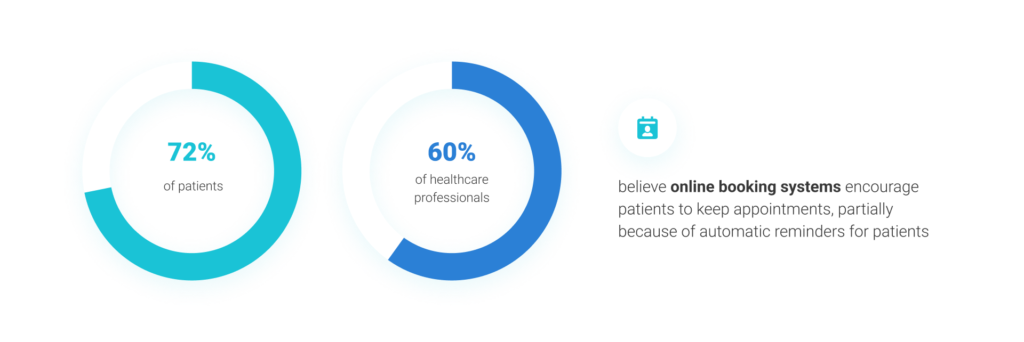
According to recent surveys, 72% of patients and 60% of healthcare professionals believe online booking systems encourage patients to keep appointments, partially because of automatic reminders for patients.
Okay, now that we’ve already praised appointment automation, let’s look deeper and see the technology that (usually) is behind that.
A rule-based (or pre-scribed) chatbot is a program designed to respond to specific user inputs based on predefined rules. It’s like a decision tree; the chatbot provides a predetermined response if a user asks a question or uses particular keywords.
It’s reliable in handling common queries and consistency in responses. At the same time, rule-based chatbots can struggle with complex or unexpected questions, limiting their ability to provide more personalized assistance. Next time, we’ll show you a bot from Unidatalab with diverse functionalities.
Use cases for prescribed chatbots
So, how far can this seemingly simple technology go in the healthcare industry? Let’s see.
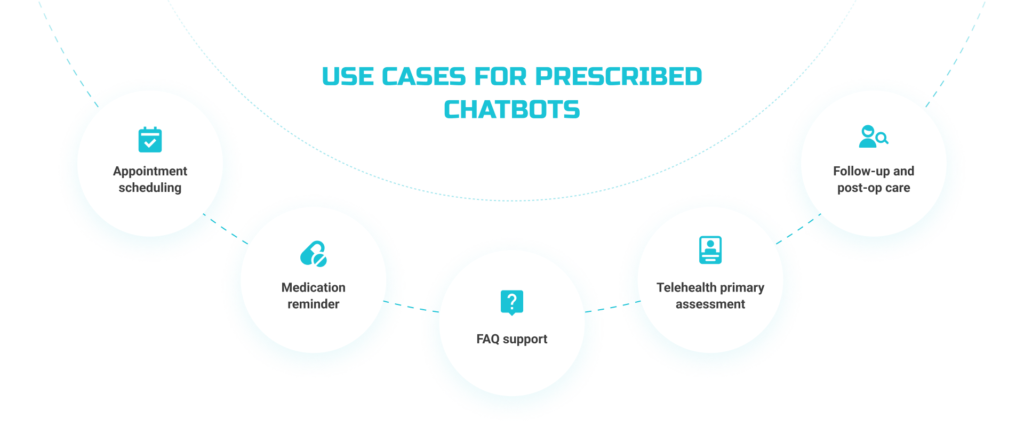
Appointment scheduling (our case). Rule-based chatbots can streamline appointment scheduling by allowing patients to book slots, check availability, and receive real-time confirmation. Healthcare providers benefit from reduced administrative work, optimized schedules, and improved patient experience, resulting in higher patient retention and operational efficiency.
Medication reminder. Chatbots of this type can send timely medication reminders to patients, reducing non-compliance and promoting better health outcomes. Reminders can be recurring, not only for specific hours; they can also work for a few days or even a week, and notifications might occur multiple times a day. Healthcare providers can leverage this automation to enhance patient adherence, potentially leading to fewer complications and hospital readmissions, thus lowering overall healthcare costs.
FAQ support. Rule-based chatbots serve as a 24/7 FAQ resource, providing patients and healthcare professionals with instant answers to common queries. This reduces the burden on customer support staff and ensures that accurate information is readily available, enhancing the overall quality of patient interactions.
Telehealth primary assessment. Chatbots can assist in initial assessments during telehealth consultations by collecting patient symptoms and medical history. This approach empowers healthcare providers with relevant information before the virtual visit, improving diagnostic accuracy and ensuring a more productive and focused consultation.
Follow-up and post-operational care. After procedures or treatments, chatbots can monitor patients’ progress, offer guidance, and address concerns. This proactive approach helps healthcare providers in the early detection of complications, reduces readmission rates, and fosters patient trust through personalized care.
All in all, chatbots can’t be a complete replacement for proper medical aids. Instead, this is a reliable helper for healthcare representatives, making their routine easier and providing primary advice or assistance to patients. As a technology, it can be a relevant addition to a healthcare startup.
Building an appointment chatbot with Unidatalab
As you know, we always testify our words with actions. This time, we created a healthcare appointment bot that will book an appointment in Google Calendar for a desired doctor at a time and date provided by a user. For this purpose, we used the RASA framework.
Rasa Open Source is a conversational AI platform that helps developers understand and engage in conversation. It can connect with messaging channels and third-party systems through APIs. Developers and businesses can use this platform to create chatbots or digital assistants.
In our case, it helps us build this bot with the necessary functionality effortlessly.
Example conversation
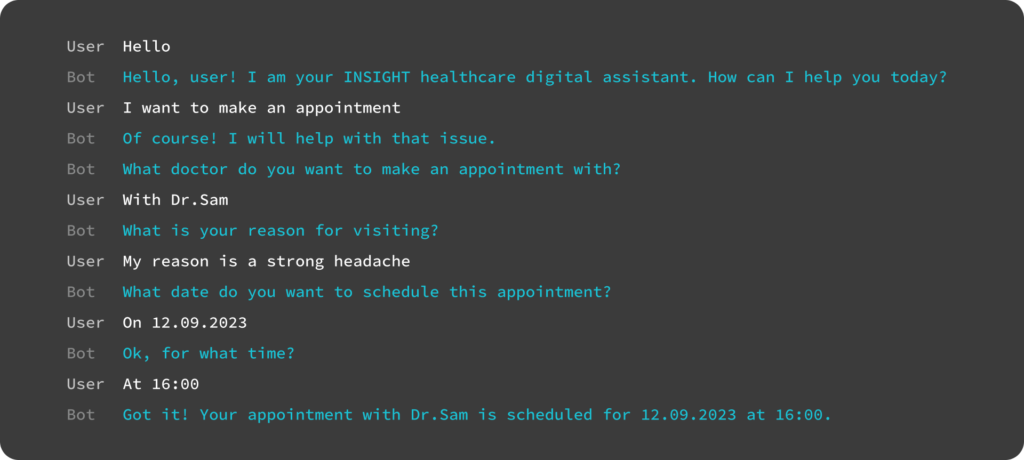
The primary function of our bot is to create appointments with doctors and add them to Google Calendar, as described above.
Here is how it works:
- The bot waits for a user’s prompt like “make an appointment.”
- When a user prompts the phrase, bots ask them (in that particular order):
- the name of the doctor,
- the reason for the visit;
- the date;
- the time
- As soon as a user provides all the required details, the bot performs the action (creates an event in the calendar) with RASA API and confirms that the meeting has been scheduled in the calendar.
So, here is an example of a conversation between the bot and a user:
The appointment on Google Calendar:
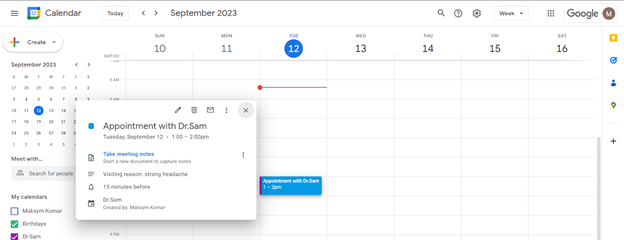
What we got
As we can see, the bot successfully handled information provided by the user and then created an appointment in Google Calendar in a separate calendar, named by a doctor’s name.
The healthcare appointment bot built with the RASA framework offers a user-friendly and efficient solution for scheduling appointments with desired doctors. RASA’s robust conversational AI capabilities and third-party integration support make it a valuable tool for creating intelligent and versatile virtual assistants or chatbots in healthcare.
Strengthening the healthcare industry with chatbots
Of course, healthcare representatives and related companies have recognized the value of such helpful healthcare digital assistance.
Here are only 5 real-life use cases where chatbots serve various purposes, helping patients and providers find a solution.
Florence. The chatbot serves as a virtual nurse, catering to various healthcare needs. She reminds patients to take their medications on time. Also, Florence can monitor factors like body weight and mood for a user’s overall well-being. This chatbot continuously learns and provides valuable insights about medical conditions. It can even help users locate the nearest pharmacy or doctor, making healthcare management more accessible.
Symptomate. This versatile, multi-language chatbot is designed to assess symptoms and guide patients on their next steps. Its workflow is simple – users input their symptoms and answer a few questions for a comprehensive assessment. Symptomate generates a detailed report with potential causes, recommended actions, and suggested lab tests, enhancing users’ understanding of their health status.
Buoy Health. The solution, reportedly developed by a team of medical professionals and computer scientists in partnership with Harvard Innovation Laboratory, utilizes a vast clinical database. Patients can easily check their symptoms online or explore their extensive knowledge base to gain insights into their health. The chatbot thoroughly inquires about users’ medical conditions and provides actionable solutions and steps based on their specific needs.
Healthily (formerly Your. MD). This chatbot offers trustworthy health information through its AI-powered symptom checker. It empowers users to make informed healthcare decisions on various platforms, including iOS, Android, and messaging apps. It also connects users with medical service providers, whether they need pharmacies, test centers, doctors’ offices, or mental health app recommendations.
OneRemission. The service aims to support individuals battling cancer. This chatbot provides valuable information, including curated advice on diets, exercises, and post-cancer practices, endorsed by Integrative Medicine experts. It empowers cancer patients and survivors to take charge of their health. Besides, users can consult with online oncologists 24/7 through the platform, ensuring convenient access to specialist guidance during their cancer journey.
Even with that pace of development, the technology will not replace human empathy and level of care. However, it will significantly streamline all every day yet necessary processes, allowing healthcare representatives to do what they are best at – to help people overcome diseases and healthcare concerns. Stay tuned for our next article; we’ll show you how far technologies are going.
We at Unidatalab are happy to be a part of it. If you have any noble, light, and bright ideas on how to do it – just let us know.